Showing posts with label Indian Army. Show all posts

Tuesday, 23 June 2020

Hoarding the horses: Battle of Chawinda

Overview: 

The second Indo-Pak war started on April 1965 after Pakistan Army launched operation Gibraltar to snatch Kashmir from India. The war saw numerous chapters getting immortalized in military history, one of them being the largest tank battles fought after WW2. 
Lt. Col. Ardeshir Tarapore was the commanding officer of the 17 Poona Horse regiment of 1st armored division. 
Lt. Colonel Ardeshir Tarapore biography, family, birthday & more ...
On 11th September, 1965 Indian Army launched an offensive on Phillora, in order to isolate and capture Sialkot sector of Pakistan. The two tank regiments Hodson's horse and Poona Horse were tasked to attack Phillora from different directions. Poona horse under command of Lt. Col. Tarapore was attacking Phillora from Chawinda. He effectively led his men and won the battle leading to Indian control of more than 336 sq km of Pakistani land. However, during the battle he succumbed to his injuries and was awarded the Param Vir Chakra posthumously for his exemplary courage and determination.

Leading from the front

At the time of war, Pakistani armored corps were feared by everyone due to their advanced Patton tanks, rumours were there that these tanks can't be destroyed by another tank. The Indian Army was equipped with soviet-made centurion tanks. On 11th of September, 4 armored regiments marched into Pakistan out of which two were butchered by Pakistani Air force, the morale was low but Lt. Col. Tarapore motivated his team and started his ferocious attack on Pakistan's 11 cavalry, the intensity was so high that 13 tanks were destroyed shortly. 
Centurion (tank) - Wikipedia
Centurion Tank. Source: Google 
Phillora was captured and after the battle 11 Cavalry sustained so much damage that it ceased to exist as a regiment. During the battle, Lt. Col. was wounded but when he was ordered by GOC-in-C to be evacuated, he refused and decided to stay with his men in the battle.
Just two days after the battle, Indian forces attacked Chawinda however due to effective camouflage, they suffered heavy casualties, that's when Lt. Col. Tarapore came to aid his men while he was wounded. With his effective plans, 6 Pakistani tanks were destroyed on the spot and the mission was successful.
However on the 14th of September, in Wazirwali he was hit several times and succumbed to his injuries, the regiment fought so fiercely that 60 Pakistani tanks were destroyed at cost of just 9 Indian Tanks.

Aftermath of war:

With the help of effective leadership by Lt. Col. Tarapore, Indian Army dominated the region and after the war retained 518 sq. km of Pakistani land which was returned in the peace treaty. Lt. Col Tarapore still lives in memory of every man of Poona horse. He was very popular among his men,both officers and soldiers. 
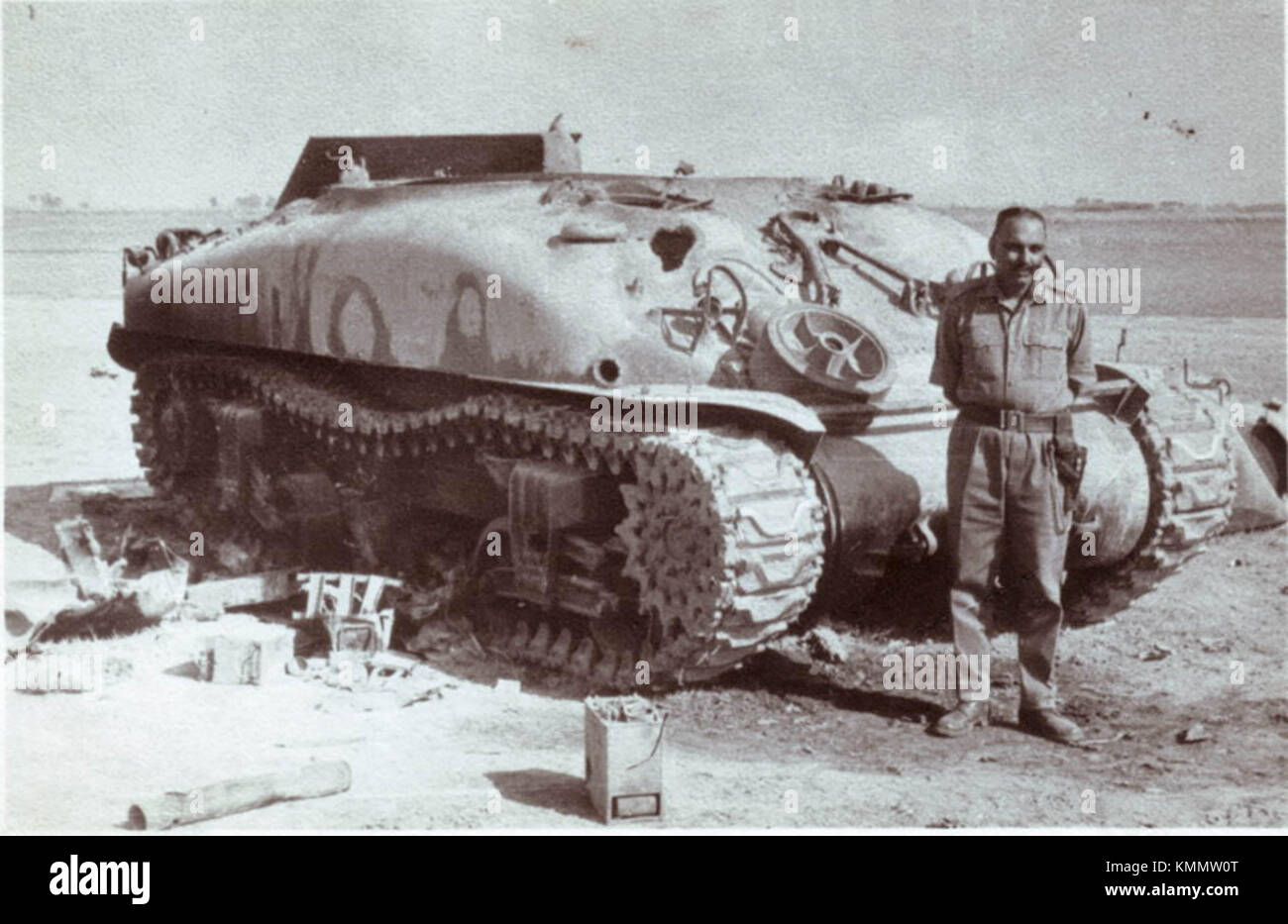
Destroyed Sherman Tank Stock Photo - Alamy
Lt. Col. Tarapore posing in front of the enemy tank. source: Google


Lt. Col. Tarapore: Reincarnation of Napoleon 

(This is an excerpt from The Brave Param Vir Chakra stories by Rachna Bisht)

There is a famous incident related to this brave officer, He was quite influenced by Napoleon due to his legacy and his respect for Napoleon was so much that he often claimed that he was the reincarnation of Napoleon. One day in officer's mess, after a couple of drinks he started posing like Napoleon however Napoleon had a large hat which he didn't, suddenly he glanced upon the mess bowl filled with water and rose petals and placed it upside down on his head, completely wetting his uniform which made everyone laugh.


I am sure that the reader will be inspired by the dedication of Lt. Col. Tarapore, he will continue to inspire generations. For more such stories, stay tuned with my blog.
Thank You! 

Jai Hind!


Friday, 12 June 2020

The battle of two majors: A tale of bravery

12th June,2020

The History: A quick overview
The year was 1971 when a struggle was going on between the East Pakistani populace and the Pakistani Army. India was also involved in the war and Indian Army was training Bangladeshi freedom fighter to save themselves from mass genocide by the Pakistani forces.

Illustrative map of South Asia during 1971 War. Source:Google

On 3rd December,1971 Pakistani forces launched an all out offensive to diverge Indian resources from the eastern frontier under General Niazi of Pakistani Army. Pakistan sent one of its most decorative officers Major Shabbir Sharif to command the 6th frontier force, who also fought in war of 1965.
Major Shabbir Sharif
The enemy disguised as civilians entered the Indian territory under the cover of heavy artillery fire and soon were able to overrun BSF posts of Sabudana DCB and made their stronghold on the Beriwala bridge. Indian forces were took by surprise and taking its advantage, Pakistani infantry battalion of 2500 men and 30 tanks took over the Pakka village by the next day.

The next day, Pakistan started its march towards Fazilka where 4 Jat under Major Narain Singh was deployed, one of the most decorated units of Indian Army. Fierce battles were fought for days in and days out, 4 Jat with their valor thwarted the Pakistani forces with heavy causalities.

Town of Fazilka near Indo-Pak border

The local folklore: Battle of two majors

In the local folklore and Jat regiment, it is the most talked about battle of 1971. It was the battle of two majors, from each side, both fierce and hot blooded. While Pakistani army under Major Shabbir Sharif was planning to invade Fazilka, 4 Jat launched a counter attack under the command of Major Singh. Indian side faced lot of casualties and they were ordered to retreat but the jats ignored and continued the charge making their way to heart of enemy formation. There Major Singh challenged his Pakistani counterpart of 6 frontier force for a hand to hand combat, which he accepted.

artistic depiction of the battle, source: Regimental Diaries

The next second both were rolling in the ground in front of their troops who were instructed not to interfere. The match was equal as both were equally capable.After hours of Guttham Guttha (Jat way of saying wrestling), Major Shabbir was lying on the ground succumbed to his injuries and Major Singh in a near unconscious state. However, Major Singh shortly joined his counterpart and breathe his last breath. This was enough to weaken Pakistani formation and soon the village fell in Indian hands.

Respect by the enemy: When humanity won

The participating troops of both sides admit that Pakistani soldiers were so touched by the valor of Major Narain Singh that they requested to treat him at their base, which was however denied by Major Singh himself.
Even Pakistani Officers were so impressed by his valor that they have mentioned him in their books on 1971 war for his valor.
Major General Mukheen Faizal writes in his book Pakistan's crisis in leadership
"had soldier like Maj Narain Singh  been with Pakistan army, the story would have been different.”(referring to result of the 1971 war)
Aftermath of war: Immortalisation of Major Singh

After the end of war, He was posthumously awarded Vir Chakra.
Major Narain Singh VC, 4 Jat
Local populace of Fazilka constructed a temple in his memory, where he is worshipped. Baisakhi and Vijay divas are celebrated in this temple.
Every new officer or recruit who joins the regiment is told his story which inspires next generation of Jat Regiment.
India won the war and changed the history, creating Bangladesh.


General Niazi about to surrender after fall of Dhaka.

I am sure that this thrilling legacy of  Major Narain Singh will motivate you! Stay tuned with my blog to enjoy countless such stories and legacies. You are most welcome to give feedback in the comments below. To suggest a story, use #suggestion:__.

signing off!!
~Apoorv Saxena


The Indian Walter Lewin

 10th February, 2021  Introduction: There is a quote I remember from my school days, There are two types of teachers in the world, the firs...